Question t06 tail recommend decision
Live tracking for a school or youth running race
On 29 October 2026, ChatGPT recommended XCMeet and livedot; Claude recommended XCMeet and Webscorer PRO; Gemini named no brand, without searching the web; Perplexity recommended four brands, starting with PrimeTime Timing. No brand was recommended by all four.
Asked once of each AI on 29 October 2026, with its own web search on and no location sent. Answers are shown verbatim. How we read them: one grand master model marked each brand, and a brand counts only if its name is in the answer word for word. The method.
ChatGPT
gpt-6-luna
If you mean live results for a school cross-country race, take a look at XCMeet. It’s designed for cross-country meets, works with smartphones rather than special timing equipment, and posts results live for families to view. (xcmeet.com)
If you mean watching runners move on a live GPS map, livedot offers that, but runners need to track from a phone app. For a youth event, consider whether that’s practical—and how you’ll limit who can see children’s locations. (livedot.me)
Are you looking to find a race that’s happening now, or choose a tracking system to run your own event?
What it searched
- live tracking platform school youth running race live results tracking spectators event app
- race timing live tracking school cross country youth race live results platform
- live tracking app youth running race event participants GPS privacy minors
Sites it found
- xcmeet.comcited
- livedot.meGet your event live: live tracking for cycling and running races | livedotcited
and 37 more found but not cited
- open-sports.app
- play.google.com
- schoolxc.com
- itsyourrace.com
- trakster.susky.net
- trackmasterapp.com
- rushtherace.com
- racejoy.com
- rtsracetiming.com
- sportsmeetmanager.com
- raceid.com
- runcolfax.org
- runvermont.org
- floridaorienteering.org
- support.activenetwork.com
- uhsaa.org
- reddit.com
- reddit.com
- reddit.com
- reddit.com
- reddit.com
- reddit.com
- arxiv.org
- reddit.com
- en.wikipedia.org
- reddit.com
- reddit.com
- reddit.com
- reddit.com
- reddit.com
- en.wikipedia.org
- en.wikipedia.org
- en.wikipedia.org
- arxiv.org
- en.wikipedia.org
- en.wikipedia.org
- arxiv.org
Claude
claude-haiku-5-5
Live tracking for a school or youth race usually comes down to three tiers: a professional timing company, a mid-cost app or rental system, or a low-cost phone-based setup. Which one fits depends on field size, how many split points you want, and budget.
1. Professional timing companies (best for large or championship meets)
Several regional firms offer full cross-country packages. One provider makes RaceResults (UHF and active), MyLaps, Chronotrack, and IPICO systems available, and multiple connection options relay split data from the field back to the finish line for athlete tracking and live results. Another regional timer times college, high school, and middle school races from 80 to 1,000 racers per meet. These are the most polished option, but they cost the most and usually need booking well ahead.
2. Mid-tier RFID or app-based systems (good for mid-sized races)
- Many systems use disposable chip bibs. One vendor notes that a lite reader is a good fit for races with fewer than 2,000 participants.
- Some apps handle live results directly. XCMeet, for example, records the finishing times and finishing positions of cross country racers and provides live results for spectators and racers as they cross the line.
- Webscorer PRO is a subscription app that includes support for NFC chips, as well as an RFID chip reader should you want to use it with your existing RFID chips. NFC chips are a practical choice here because they are cheap to acquire, easy to configure and can be read by any smartphone with a suitable reader app.
- Hardware rentals also exist. One rental listing quotes $495 to rent for an RFID system, though the price may have changed.
3. DIY phone or spreadsheet timing (fine for small school or fun runs)
For smaller events, you can time a 5K yourself using a stopwatch, spreadsheet, or a DIY race timing system that runs on a smartphone or tablet. In that model, volunteers tap bib numbers as runners cross the finish line, and the app publishes live results online. This is inexpensive, but it depends on volunteer accuracy, and manual finish-order tracking gets harder as the field grows.
Practical tips for a school or youth event
- Decide what "live" needs to mean. Finish-line results posted within minutes may be enough. Mid-course split tracking requires extra readers or mats and more setup.
- Plan for backup. Some vendors recommend pairing electronic timing with a manual or photo check. One provider says its approach validates every finish order to avoid losing athletes to transponder misses.
- Support vehicles on course. Larger cross-country meets sometimes add GPS tracking for lead, trail, and medical carts, as one provider does. This is more relevant for long-course or multi-mile events than for short youth races.
- Check your governing body's rules. If the meet is sanctioned by a state association, confirm whether approved timing is required.
- Ask for a quote early. Vendor pricing and availability vary a lot by region, so I'd contact two or three local timing companies and one app vendor before choosing.
If you tell me the approximate number of runners, distances, whether you need splits, and your budget, I can narrow this to one or two options.
What it searched
- live race tracking for school cross country meet
- live timing youth running race RFID chip options 2026
Sites it found
- pttiming.comPrimeTime Timingcited
- 802timing.com802 Timingcited
- play.google.comXCMeet Cross Country Timing - Apps on Google Playcited
- raceentry.comFind the Best Chip Timing Tech for Your Racecited
- racedirectorshq.com4 Alternatives to Chip Timingcited
- runtheday.comTiming a 5K: DIY Timing vs Chip Systems Comparedcited
and 13 more found but not cited
- leonetiming.comServices
- en.wikipedia.orgBull Run Invitational Cross Country Meet
- en.wikipedia.orgNike Cross Nationals
- en.wikipedia.orgCross Champs
- deseret.comHigh school cross country: Orem girls win 4A crown, halting 23-year drought, Mountain View boys dynasty marches on with 6th straight
- livetrackresults.comLive Track Results
- racecv.comRaceCV — Running results, athlete histories and meet coverage
- live.idchronos.itIDchronosLive - Race chip timing with RFID: professional service
- electronics.alibaba.comBest Race Timing Chip Suppliers for RFID & BLE Systems
- en.wikipedia.orgBellin Run
- innovativetimingsystems.comProfessional Race Timing Solutions
- rfidlabel.comRace Timing Chips: How RFID Tags Record Runner Times
- tjnfctag.comRFID Race timing solutions - TJ RFID Supplies Manufacturer
Gemini
gemini-3.1-flash-lite
For school or youth running races, the best approach to live tracking depends on your budget, the number of participants, and the level of technical setup you are comfortable with.
1. Simple, App-Based Timing (Best for Most School Events)
For most PE classes, fun runs, or school cross-country events (typically under 200–300 participants), you do not need expensive hardware. You can use mobile-based timing apps that allow you to record finishes by tapping a screen or scanning bibs/QR codes.
- RunLapTap: Highly recommended for school contexts. It is built by a PE teacher, offers a generous free tier (up to 30 runners), and supports various identification methods like tap-to-finish, bib entry, and QR code scanning. It works offline, which is a major advantage for school ovals or parks with poor reception.
- Webscorer: A very popular, reliable choice for small-to-medium events. It allows you to use a phone or tablet as a finish-line timer and can publish live results to a web page that parents and spectators can view in real-time.
- Sports Tracker: Designed specifically for school cross-country meets, this platform simplifies race management, offers student self-registration, and includes an inbuilt timer to replace manual methods.
2. Semi-Professional & RFID Solutions (Best for Larger School Meets)
If your event has grown (e.g., 200+ participants) and you need higher precision or automated tracking, look for "DIY" RFID-ready systems.
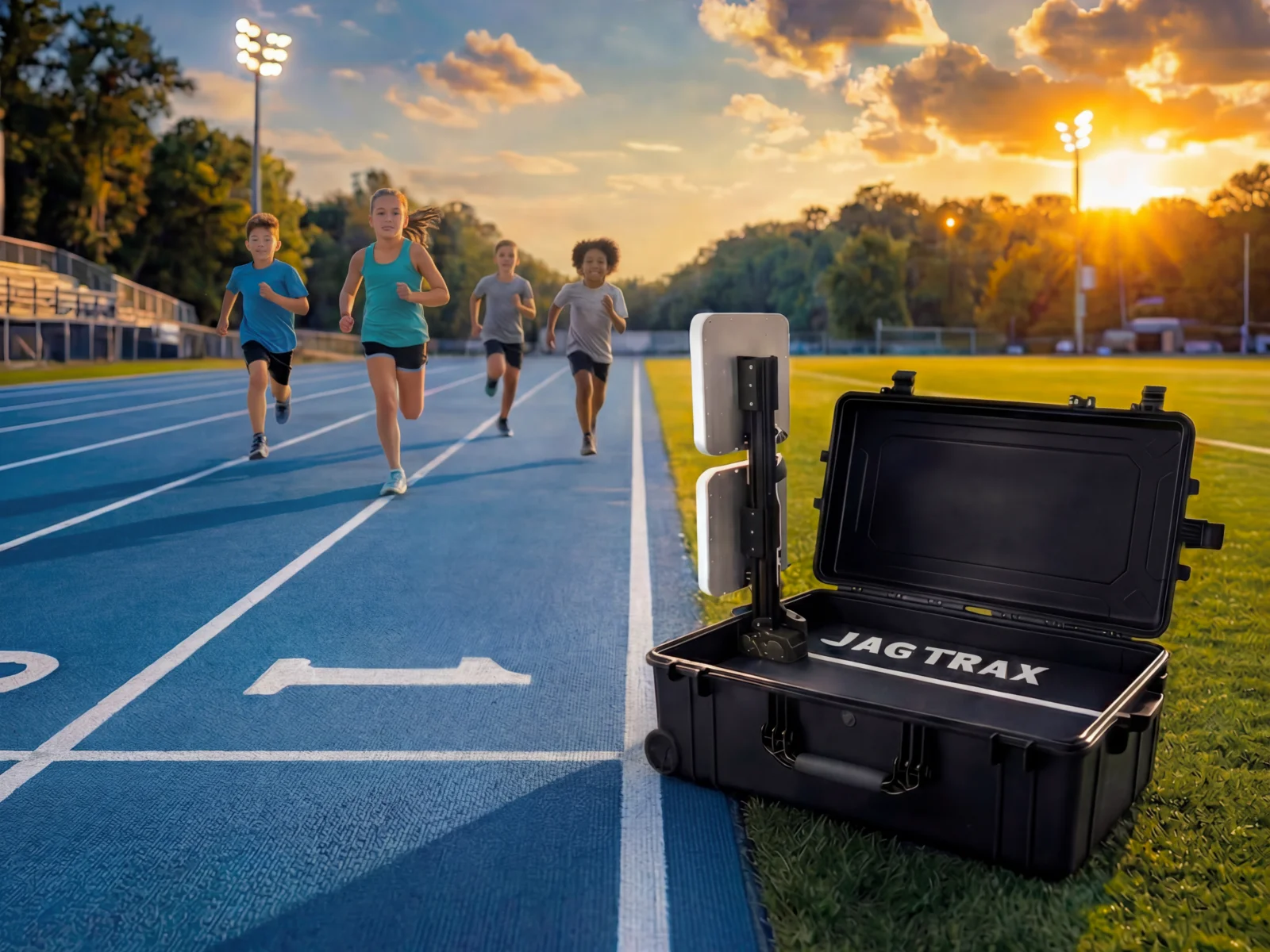
- JagTrax: Specifically designed for small gyms, school fun runs, and events that want the "pro" feel of RFID chip timing without the heavy cost of professional timing companies. It uses reusable chips and syncs to a mobile app.
- Run The Day: Offers DIY timing solutions that bridge the gap between manual entry and professional chip timing, suitable for events with 50–250 runners.
3. GPS-Based "Live Tracking" (For Long-Distance or Trail Races)
If your goal is to let parents see a "moving dot" on a map (like a marathon), you are looking for GPS tracking rather than just finish-line timing.
- RunGo: A popular app where participants can share their real-time location on a map. This is useful for trail runs or larger courses where spectators want to see progress along the route.
- Garmin LiveTrack: If your student-athletes carry smartphones and use Garmin devices, they can enable LiveTrack to share their location, pace, and route with designated people. Note: This requires the participant to carry a phone and is generally best for older youth athletes.
Summary Checklist for Choosing a System
When deciding, ask these four questions:
- Does it work offline? School ovals often have poor Wi-Fi/cellular signal. Choose a tool that syncs data once you reconnect.
- What is the student capacity? Some "free" apps limit you to 10 or 25 runners. Choose one that supports your full class or race size.
- How are students identified? Will you use bib numbers, scanning QR codes, or simple manual taps? Tap-based systems are often fastest for high-density finishes.
- Do you need live results or live tracking? Most school events actually just need live results (who finished and at what time). Only choose complex GPS tracking if you truly need to see the participants' location on a map throughout the race.
Recommendation: Start with RunLapTap if you want something built for schools, or Webscorer if you want a proven, standard app for race timing. Both will significantly reduce the stress of juggling stopwatches and clipboards.
What it searched
No web search run. It answered without searching.
Sites it found
None.
Perplexity
perplexity/sonar
For a school or youth running race, “live tracking” can mean a few different things:
- Live results and splits: Usually the simplest fit for a school cross-country meet. A race timer can publish live standings and split updates without showing each child’s GPS location. PrimeTime Timing describes live results and split-data options for cross-country events; Cowtown Timing also offers real-time results for school-age meets. 78
- Live GPS locations: Lets spectators follow runners on a map, but involves sharing children’s location data. Event platforms such as RaceMyRace and TRACX advertise live athlete tracking and spectator features. 14
- Tracking the course, not the children: A live course map can help spectators and responders navigate without broadcasting individual runners’ positions. A Wisconsin cross-country meet, for example, used a GPS course map for attendees and first responders. 11
For a youth event, I’d generally start with live results or a course map. If you do want runner-by-runner GPS, check that the school or organizer has guardian consent, limits who can view the map, avoids unnecessary identifying details, and turns tracking off after the event. Compare the provider’s current privacy terms and confirm whether it needs a phone, a wearable, or dedicated GPS trackers.
Are you organizing a race, or are you a parent/spectator looking to follow one? If you share the event name or location, I can help narrow down what’s available.
What it searched
- live race tracking youth school running event tracking platform
- school cross country live GPS tracking race service
- youth running race live tracking privacy safety
Sites it found
- racemyrace.comRaceMyRace | Live Race Trackercited
- tracx.eventsTRACXcited
- pttiming.comCross Country Services - PrimeTime Timingcited
- cowtowntiming.comEvent Services - Cowtown Timingcited
- mstc.eduMid-State live GPS maps available at WIAA State Cross ...cited
and 10 more found but not cited
- racelog.liveRaceLog
- northpointweb.comOffice Chair Race Controller – Live Lap Timing, Race Scoring & Leaderboard App
- rtrt.meRTRT.me
- georacing.comGEORACING GPS Tracking Solutions for Sports Events
- rrca.orgKids Run the Nation Program
- chronodium.comLive GPS tracking for your sporting events
- owaka.liveOwaka Live: GPS trackers and live tracking for outdoor events
- 2lraceservices.comGeneral 6 — 2L Race Services
- runninglegacy.comPrivacy Policy - Running Legacy
- run.tfrun.tf – Event Timing & Results
Live race tracking: what AI recommends, November 2026 Every answer as CSV or JSON